
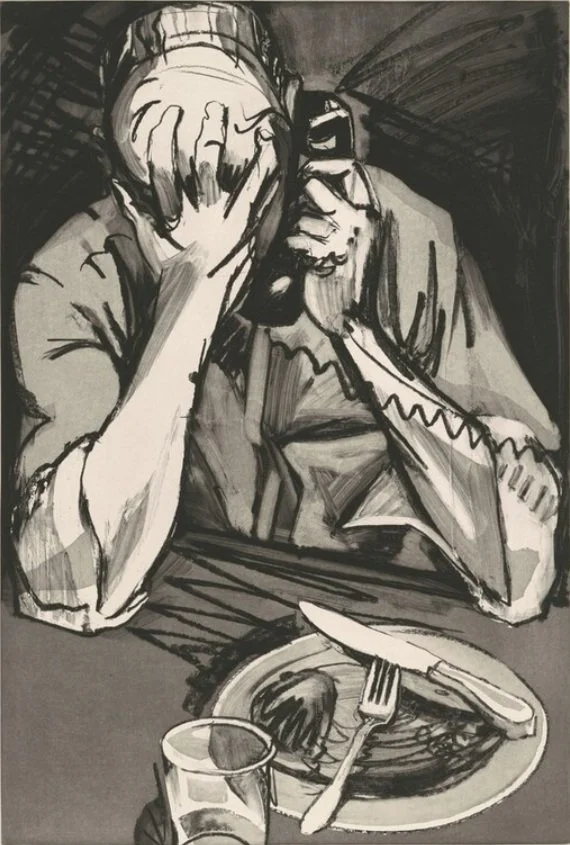
©Mike Glier, 2026, member ARSNY
Glier, M. (1986). Untitled (Telephone) [etching [proof]]. National Gallery of Art, Washington, DC, United States. https://www.nga.gov/artworks/66836-untitled-telephone
Image used with the permission of the artist.
Growing up surrounded by “divorce happy talk” and widespread divorce acceptance in the culture, I did not recognize my parents’ divorce as a wound until a few short years ago. Once that was uncovered for me by a compassionate priest, himself an adult child of divorce (ACOD), I began to see that there are layers of trauma caused by the divorce. In therapy, I am diving into the anxiety especially, and now I find myself here: studying hidden grief, and surprisingly, anger. Other ACODs have talked about their anger towards their parents, and I would think, “Gosh, that sounds awful. My anxiety is bad, but I don’t have any anger issues with my parents.” Go ahead and laugh if you want, but I truly believed that. I knew I felt sad, but mad? Never.
Well, I am finding that I am angry. It is easier for me to see the ways in which I am angry with my mom. I have lived with her; we stayed in touch better after I moved out. She is still alive. I can talk to her. I can acknowledge how she has hurt me and begin to forgive. It is a different case with my dad, who died in 2012. My dad, who was often a big kid himself—I mean, this is the guy that destroyed his knees on the slip-n-slide because that is what we kids wanted to do—will never meet my children on this side of heaven. I am angry about that. My dad typically waited for me to call him, and often we would go months without talking. I am angry that it was my responsibility to call. I never knew my dad could be poetic until the last phone call we shared; I am angry that I did not know. And that’s where this play comes in…
My husband proposed in May 2012; when I called my dad to share the news and invite him to our wedding, he said no. My dad claimed that if he came, it would be the “jinx of Johnny,” as if his very presence would doom my marriage. That phone call was the first and only time I got into a shouting match with him. Two months after this invitation, our final phone call took place. When he died just three months after our argument over my wedding, and a single month after our very last phone call, I buried that anger. To make sure it stayed hidden, I even buried my grief over his passing for years. I told myself that I did not know him that well, and I have had so many stepparents; surely it was no big deal. Society said, “You are fine.” I said to myself, “I am fine.” Turns out I was not fine; I am not fine, though I am getting better. I want more than fine. I want to live a full life in Christ, with my incredible family. In order to do that, I have to keep walking my ACOD wounds on the healing road with Jesus. Thus, the second episode of “The Conversations I Didn’t Have.”
Introduction to Play Reading and Drama Therapy
If you read the first episode, “The Laugh,” then you know what to expect—skip ahead to the script itself.
Reading a Play:
Here are the basics of reading a play:
Plays are meant to be seen and heard on a stage. Doing your best to visualize the play as you read is the best experience of reading a play.
Before the play begins, there are character descriptions, setting details, and other notes to help you really place the action in a firm mental picture. Skipping over them makes the dialogue more confusing.
Italicized words are stage directions. Stage directions can indicate specific movement, what the stage looks like, subtext of how a character is feeling, or clues for actors as they’re playing the part. Use these to help you imagine each scene as it plays out.
Names of the characters indicate which actor speaks when, and would not be spoken out loud, unless the name is in a line of dialogue.
Style notes: This particular play is episodic, and has a character that ‘breaks the fourth wall,’ which is when a character addresses the audience directly as though they are not in the play entirely. In traditional Western theatre, actors play the characters as though they are unaware there is an audience; the audience makes up the ‘fourth wall.’
Drama Therapy:
According to the North American Drama Therapy Association, drama therapy is “...the intentional use of drama and/or theater processes to achieve therapeutic goals…This approach can provide the context for participants to tell their stories, set goals and solve problems, express feelings, or achieve catharsis…” I am not a drama therapist, but I am a drama teacher currently IN therapy, and have discovered playwriting to be an incredible source of processing and healing on my journey as an ACOD. Writing and reimagining events and conversations of my past is helping me make sense of my responses and learned behaviors over the years; this, in turn, is allowing me to manage those responses and use positive coping techniques. God is using this dialogue as stitches and healing salves on the wounds of my heart.
And now, the show.
Episode 2 – The Phone Call
LOCATION – Colorado, or somewhere along the Rocky Mountains. Small town on the western side of the mountains (DAD); big city on the eastern side of the mountains (AJ).
CHARACTERS –
AJ – Now in her late 20s, our heroine is a busy young woman. She works at least forty hours each week at the coffee shop, she has three cats, she spends many of her evenings in rehearsal at the local community theatre, and she is doing all of her wedding planning on her own. We have less than four months until the big day. Although she has always known her dad, it has mostly been through letters and phone calls, with the occasional visit, since she was three. She spent most of her childhood and adolescence halfway across the country from him. In 2007, exactly seven days after graduating college, AJ moved back to her beloved Colorado and the Rocky Mountains. For the past six years, only a five-hour drive over the mountain range has separated them. Neither of them have yet made this drive.
DAD – AJ’s father, two months away from his 60th birthday. He has worked as a certified nurse’s assistant for the past twenty-five years, and while he never talked about faith or religion, he would often say, “I’ve been put on this earth to take care of God’s sick and broken.” He has worked hard at his job. Although he and Merci have been together more than twenty years, they never officially got married; Merci is a few years older than him.
AJ (ADULT) – Our not-quite-narrator returns! She is in her forties. She is more solemn than in our last episode; there is regret and grief closer to the surface here. A reminder—she is something of a narrator, but she should not give off narrator vibes in the staging. Use your imagination to decide when/if she exits, or if she is part of the entire show. Maybe she is one of the other baristas or a customer; maybe she watches from a dimly-lit corner; maybe she plays both ages of herself.
STAGE SETTING – The stage is split between AJ’s coffee-shop-job patio and her dad’s living room. The characters are separated by more than just the five-hour drive between them, and you can choose to reflect that or not in the physical separation of their respective locations. This memory lives in 2012 so consider adding something nostalgic from that time period. AJ still has a flip phone; DAD has a landline and no need for cell phones.
The stage is split. On stage left, we see the patio of the coffee shop where AJ works. Stage right is a living room, with a well-loved ugly armchair, one side table with medical equipment, and one with a landline phone on it. Note - At all times, there is a clear boundary between the two characters center stage. However, both actors are relatively close to that boundary, at times bumping up against it. AJ has more flexibility with her movement, while DAD is tied to his landline phone. Let that metaphor weigh as heavily or as subtly as you choose.
Round One
AJ (ADULT) is center stage, as close to having a foot in both worlds as possible. Lights and sound should give us the feeling of being worn down, maybe making us sigh a little with our own exhaustion.. Her own spotlight hits her, and she says:
What didn’t really happen: communication, compassion, and understanding.
As the lights fully come up on our scene, we see DAD sitting, stage right, in his favorite armchair, a crocheted blanket draped across its back. His head is in his hands; he is struggling with the weight of his partner’s illness and rapid decline. On stage left, we see AJ come out onto the patio. She takes off her work apron, pulls her flip phone out of her pocket, checks the time, takes a breath, and dials. Immediately DAD’s phone rings. He checks the caller ID before he answers.
DAD
Hello? (For flavor, his eastern Colorado accent makes this sound like ‘YEL-low.’ AJ does not have this accent.)
AJ
Hey Daddy-O, it’s me!
DAD
(Chuckles.) Well, would you look at that!
AJ
How’s it going?
DAD
Can’t complain.
AJ
Sorry I haven’t called in so long, I’ve been super busy—
DAD
—I know how busy you are shweetheart—
AJ
—between work, and my rehearsal schedule, and planning the wedding, it’s just been a lot. (Awkward silence.) So, anyway, how are you? How’s Merci?
DAD
(Hesitates.) Merci’s… not doing her best.
AJ
(Almost laughs.) What do you mean?
DAD
She’s sick, Mandy. Been sick for quite a while. Not lookin’ like recovery anytime soon.
AJ
Wait, what did her doctors say?
DAD
Mandy, you know how they are, they just don’t—
AJ
—no Dad, I don’t know. This is the first time you’ve even told me she’s not feeling well, let alone a long recovery—
DAD
When was I s’posed to tell you?
AJ
(Stung.) I said I was sorry I hadn’t called—
DAD
—Now I’m not tryin’ to make you feel bad—
AJ
—I wish YOU had called ME. (Silence.) You could have said, I don’t know…anything. Something! (Silence.)
DAD
I could’ve done. Guess I din’t know how.
AJ
I guess so. (They pause, neither sure what to say.)
DAD
(We can hear his voice start to crack.) It rained yesterday.
AJ
(Confused at the turn of conversation.) Um, here too, Dad.
DAD
It’s raining again today. I knelt right down next to her, and I told her (his voice totally breaking now), I said, Merci, that’s the angels cryin’ for you. They hate the pain you’re in. They’re waiting for you to come home to them. And they’re still cryin’ for her today, Mandy.
AJ
How can I help? What do you want me to do, Dad?
DAD
Come out. Come see her. (Choking up, then reining his sorrow in.) It might be the last time.
AJ
(Shocked.) Oh Dad…she’s really that bad?
DAD
It might even cheer her up, she’s always loved you, just as much as her own daughters.
AJ
Oh Merci. Oh Dad, I’m so sorry. I’ll talk to my boss right now, it’s a five-hour drive, I’ll see you tomorrow night.
DAD
Are you sure?
AJ
Tell her to wait for me, okay? She’s feisty enough, she’s always been so, so strong…(The understanding that she is losing her stepmother is finally, actually sinking in.) How can, I mean, she’s only what, sixty-something?
DAD
(In control for both of them.) Amanda Jean, you stay strong. Drive safe. Come back and tell her goodbye.
AJ
(Sniffling.) Okay Dad, okay, I can do that. I’ll call you just before I leave my apartment so you know what time to expect me tomorrow, okay?
DAD
Alrighty then. Who loves you, baby? (This is their ritual end to all phone calls and visits.)
AJ
You do.
DAD
I do, I do, I do! I love you more than the whole wide world. Take care of yourself.
AJ
Love you too, Dad. See you tomorrow. (They hang up. AJ moves with determination to make arrangements to go and see her stepmom as the lights fade out.)
Round Two
AJ (ADULT) is once again center stage, straddling both worlds. Her light comes up.
AJ (ADULT)
What AJ wanted to happen: to be treated like the daughter of her father.
Same set-up as round one, but give us some brighter light, some daydream quality. Rose-colored glasses, as it were. This time, it is DAD who calls AJ.
AJ
(She’s on her break and realizes her phone is buzzing away in her pocket. She looks at the caller ID, is surprised for a moment before she answers.) Hey Daddy-O! I wasn’t expecting you to call.
DAD
(Chuckles.) How do you like that, your old man can still surprise you! (They laugh; on purpose, his laugh is trying to sound like Woody the Woodpecker, which made AJ giggle endlessly as a kid.)
AJ
So how’s it going?
DAD
Can’t complain too much.
AJ
Sorry I haven’t called in so long, I’ve been super busy—
DAD
—I know how busy you are shweetheart—
AJ
—between work, and my rehearsal schedule, and planning the wedding, it’s just been a lot. (Awkward silence.) So, anyway, how are you? How’s Merci?
DAD
(Hesitates.) I gotta tell you the truth Mandy, that’s why I called.
AJ
What do you mean?
DAD
Merci, well. She’s not, her health isn’t what, dammit I’m no good at this. She’s not doing so good. She’s sick. Been sick for quite a while. Not looking like gettin’ better anytime soon.
AJ
(Shocked.) Wait, what did her doctors say?
DAD
Down at the hospital they’re saying three months, maybe four.
AJ
(She gasps.) Oh no Dad…I, I don’t know what to say. (Silence for a moment. The idea of her stepmother’s death is sinking in.)
DAD
(We can hear his voice start to crack.) It rained yesterday, Mandy.
AJ
Here too, Dad.
DAD
It’s raining again today. I knelt right down next to her, and I told her (his voice totally breaking now), I said, Merci, that’s the angels cryin’ for you. They hate the pain you’re in. They’re waiting for you to come home to them. And they’re still cryin’ for her today, Mandy. I want you to come out and see her. Tomorrow, if you can make it.
AJ
Okay Dad, I can do that. I’ll just make some calls and pack a bag, I can be there by tomorrow night.
DAD
Call your mom and tell her too, would ya? They were almost friends, and I know your momma is tender-hearted, she might wanna call Merci and say goodbye.
AJ
(Somewhat surprised, but happy about the connection.) Oh um, okay, I’ll do that right now.
DAD
Good. Tell her I said hello.
AJ
Sure thing. Then I’ll call you just before I leave my apartment so you know what time to expect me tomorrow, okay?
DAD
Alrighty then. Who loves you, baby?
AJ
You do.
DAD
I do, I do, I do! I love you more than the whole wide world.
AJ
Love you too, Dad. See you tomorrow.
DAD
Take care of yourself and be safe.
AJ
I will. (They hang up. AJ moves with determination to make arrangements to go and see her stepmom as the lights fade out.)
Round Three
AJ (ADULT) is back, same setup as before; there is a grieving quality to her.
AJ (ADULT)
What really happened: the phone call I still regret.
As before, so again. Lighting should reflect that this is the real deal, including the rain at DAD’s apartment. AJ exits the coffee shop, checks the time, and calls DAD.
DAD
Hello? (For flavor, his eastern Colorado accent makes this sound like ‘YEL-low.’ AJ does not have this accent.)
AJ
Hey Dad, it’s me. Sorry I haven’t called in so long, I’ve been super busy—
DAD
—I know—
AJ
—between work, and my rehearsal schedule, and planning the wedding, it’s just been a lot. (Awkward silence.) So, anyway, how’s things? How’s Merci?
DAD
(Hesitates.) Merci’s not doing so good.
AJ
What do you mean?
DAD
She’s sick. Been sick for quite a while.
AJ
Wait, what? What did the doctor say?
DAD
Mandy, you know how they are, they just don’t—
AJ
—no Dad, I don’t know. This is the first time you’ve told me she’s not feeling well.
DAD
(Angrily, hurt.) When was I s’posed to tell you?
AJ
(Stung, also escalating.) I don’t know, you could’ve left a voicemail maybe?
DAD
I’m doing the best I can, takin’ care of her. (Silence.)
AJ
Well tell her I love her. I have to get back to work in a few minutes Dad, I’m sorry.
DAD
(We can hear his voice start to crack.) It rained yesterday, Mandy.
AJ
(Confused at the change in conversation.) Here too, Dad.
DAD
It’s rainin’ again today. I knelt right down next to her, and I told her (his voice totally breaking now), I said, Merci, that’s the angels cryin’ for you. They hate the pain you’re in. They’re waiting for you to come home to them. And they’re still cryin’ for her today, Mandy. (Silence. AJ is at a total loss for words. DAD reins in his sorrow.) It was good that you called.
AJ
Yeah, sorry it’s been a minute—
DAD
—no no, I know you’re busy—
AJ
—but I do need to get back from my break.
DAD
I love you, Mandy. More than the whole wide world.
AJ
Love you too Dad. Talk to you later. (They hang up. AJ looks concerned briefly, but then steps back into her overly-filled busy schedule.)
AJ (ADULT)
(Solemn.) I wish I could tell you that I called him back the next day. Or even the next week. But that wouldn’t be true. Merci died six weeks after that phone call. I never saw her, in all that time. I didn’t understand that she had cancer, and it was terminal, and that I would never see her again. It didn’t seem possible; I was twenty-seven, and in my mind, she wasn’t old enough to be close to death. I sometimes blame myself for not understanding what my dad was trying to tell me. “The angels are crying for you, Merci.” He was trying to tell me how bad things really were. But I didn’t know him that well, and for some reason, he couldn’t spell it out for me. My parents divorced when I was three and I never lived with him. Most of my life, I lived over one thousand miles away from him, so I didn’t understand him. I couldn’t have. But that did not stop me from blaming myself.
Merci died on November eighth, eleven days before my dad turned sixty. He didn’t call me then, either. I found out later that he did not go to her funeral. He started throwing away photo albums. He put all of his financial information in a briefcase for me. He stopped taking heart meds I didn’t even know he was on. And then?
My father died four days before his sixtieth birthday. Four. Days. The coroner’s report says heart failure…he died of a broken heart.
At first, I was angry at him—I was going to call him on his birthday, why couldn’t he wait? Then I was angry at myself—I had felt the urge to call him for a week before his birthday. Why did I ignore it? Knowing Jesus as I do now, I know that was the Holy Spirit begging me to listen. But I didn’t know. And I didn’t call him. This phone call was the last time I spoke to my father. It was short. I wasn’t compassionate. We didn’t understand one another, or really even try to. The call was short and I was short… but the memory is long. “The angels are crying for you, Merci.”
Blackout. End of play.
Prayer:
Heavenly Father,
In the noise and bustle of this world, lead us with Your voice and love. Strengthen and sustain us in the relationships You have placed in our lives. Help us to communicate clearly and with love. When communication fails, when we struggle to be heard, when we strive to listen, place us in the Sacred Heart of Jesus, the fountain of healing. When words cause us pain, anger, anxiety, or grief, fill us with the Holy Spirit so that our hearts might be protected; help us, too, to listen to the promptings of the Holy Spirit. Perfect Father, guide us as our earthly parents are unable to. Increase in us the virtues of wisdom, humility, fortitude, and above all, love. Amen.
About the Author:
Amanda is a Catholic convert, wife, mother of two boys, theatre maker, and teacher. She attended the LGW retreat in Denver in 2024 and 2025, and on her healing journey she is becoming a fierce advocate for adult children of divorce and supporting ministries. Amanda loves to cook, garden, read, and hike, especially with her family, and is a joyful and active member of the Spirit of Christ Catholic Community in Arvada, Colorado.
Reflection Questions for Small Groups or Individuals:
Have you discovered surprising emotions towards one or both of your parents over the years? How did you/are you looking at those emotions?
Do you find it difficult to communicate with one or both of your parents at times? What does that look like when you need to have a challenging conversation with them, or share important news?
Do you have any conversations with your parents that you relive often? If so, consider writing your own short play modeled on Amanda’s.
What thoughts and emotions came up for you as you read, or watched, this play? How did it speak to you?
If one, or both, of your parents is deceased, what was your last conversation with them? How has it stuck with you after all this time?
Healing happens when we journey together. To aid you in this journey, we created a quiz to better understand the impact of parental divorce on your life.
Answer 35 questions and we will send you a personalized report.
If you’re an adult child of divorce or separation, this quiz is a space to reflect on how your past may still be impacting your present—especially in areas like faith, identity, relationships, and family life. You’ll respond to a series of statements that invite honest self-reflection. At the end, you will receive insight into your potential, deepest areas of pain—and suggestions for next steps in healing.