
What Didn’t Happen, What I Wanted to Happen, & What Really Happened: Three Versions of a Scene From Middle School Me. Episode 1— The Laugh
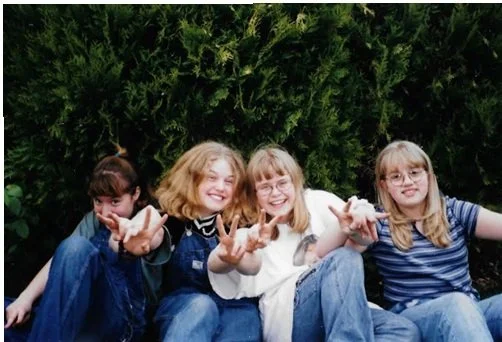
In 1997, the author (left) and three of her friends formed a band and took this picture for their future album cover shot. The album never materialized, but the girls remained friends through high school.
Image used with the permission of the author.
Anxiety, am I right? I’m living it; as a fellow ACOD, the odds are you fall somewhere on the spectrum from ‘minorly experienced it’ to ‘consumed by it on the daily.’ Do you relive embarrassing or anxiety-ridden moments of your past? Me too. Did you struggle to ‘fit in’ as a child of divorce? Same here. Did you, maybe, not even know that the child-of-divorce identity was writing your scenes? I had no clue. With the support of my therapist and my love of theatre, I have decided to do some rewrites; this is the first in a series of recollection reimaginings. Does it change my past? Of course not. But these rewrites are a gift to current me—because it allows me to process—and future me—as a way to remember I do not have to live in hiding and in shame. I can live in the joy and peace of Christ, and so can my past.
Remember, you are not alone. You don’t have to live in the anxiety, shame, and fear that accompany an ACOD. Jesus loves you, recklessly and without embarrassment of you. Your Life-Giving Wounds community walks these paths with you, too.
Introduction to Play Reading and Drama Therapy
If you have never read a play before, or have perhaps not heard of drama therapy, I would like to take a few moments to guide you into this reading. Feel free to skip anything in this introduction that you are already familiar with.
Reading a Play:
Here are the basics of reading a play:
Plays are meant to be seen and heard on a stage. Doing your best to visualize the play as you read is the best experience of reading a play.
Before the play begins, there are character descriptions, setting details, and other notes to help you really place the action in a firm mental picture. Skipping over them makes the dialogue more confusing.
Italicized words are stage directions. Stage directions can indicate specific movement, what the stage looks like, subtext of how a character is feeling, or clues for actors as they’re playing the part. Use these to help you imagine each scene as it plays out.
Names of the characters indicate which actor speaks when, and would not be spoken out loud, unless the name is in a line of dialogue.
Style notes: This particular play is episodic, and has a character that ‘breaks the fourth wall,’ which is when a character addresses the audience directly as though they are not in the play entirely. In traditional Western theatre, actors play the characters as though they are unaware there is an audience; the audience makes up the ‘fourth wall.’
Drama Therapy:
According to the North American Drama Therapy Association, drama therapy is “...the intentional use of drama and/or theater processes to achieve therapeutic goals…This approach can provide the context for participants to tell their stories, set goals and solve problems, express feelings, or achieve catharsis…” I am not a drama therapist, but I am a drama teacher currently IN therapy, and have discovered playwriting to be an incredible source of processing and healing on my journey as an ACOD. Writing and reimagining events and conversations of my past is helping me make sense of my responses and learned behaviors over the years; this, in turn, is allowing me to manage those responses and use positive coping techniques. God is using this dialogue as stitches and healing salves on the wounds of my heart.
And now, without further ado, I hope you enjoy the show.
Episode 1: The Laugh
LOCATION – Small Farming Community and Town, Minnesota
CHARACTERS
AJ – Our 11-year-old heroine. Her mom is not rich, her parents are divorced, she plays piano, and she helps take care of her younger sister. She wears hand-me-downs, forgets to brush her hair at times, and is very conscious that she does not—and probably never will—fit in. However, she loves theatre and music, feels at home on a stage, and dreams of being a Broadway star in New York City.
ASHLEY – Every hero needs a best friend, and Ashley is AJ’s. Ashley is the oldest of four daughters, lives on a farm with her loving parents, and although she is not ‘popular’ at this point, she fits in better than AJ, and popularity is in her future.
BEN – The romantic interest. A charming sixth grade boy, and one of the oldest kids in their class, he seems a touch more mature because of his sarcastic streak. The youngest of three children, he is raised in town by two loving parents, one of whom is the English teacher they will all have in seventh grade. He, like AJ, dreams of New York City; he is a better piano player than AJ.
AJ (ADULT) – Our heroine all grown up. She is in her forties. She is secure and sure of herself. She is something of a narrator, but she should not give off narrator vibes in the staging. Use your imagination to decide when/if she exits, or if she is part of the entire show. Maybe she is one of the lunch ladies; maybe she watches from a dimly-lit corner; maybe she mysteriously appears and disappears throughout.
CHILDREN – The witnesses to the event. These are the cliques of middle school. Cast as many, or as few, of these as desired. Alternatively, sound cues can be used for their crowd noise.
STAGE SETTING
A cafeteria in a middle school located in a small town in Minnesota. The school was built when the community was bigger. The specific school year was 1996-1997, though that does not really matter, as long as no one has cell phones.
The drama we are walking into: ASHLEY and AJ both have middle school crushes on BEN; they have all been going to school together since halfway through fourth grade, when AJ moved to town from Colorado. AJ’s parents divorced when she was three, and she has not lived with her dad since. Her mom moved them to Minnesota for a job. ASHLEY and BEN have known each other since first grade. AJ and BEN take piano lessons from the same teacher, are both in theatre, and cross each other’s paths often. ASHLEY and AJ are best friends.
In the dark, we hear the sounds of a middle school cafeteria staff preparing to be swarmed by children; the plastic clicking of trays, snorts of laughter, something gets spilled, etc. Allow the smell of canned beets to permeate the space. The lights come up, and we can see a cafeteria table or so stage left (SL)—use your imagination to give us a clear feel (after all, most of us have been there). Mainly, there is a buffet style counter and kitchen; the audience sees the action through the eyes of the kitchen staff. Feel free to paper it with 90s lunch lady décor. Give it all a small town, this-school-was-built-in-the-50s vibe. Be as detailed or not as you choose. For each vignette, the students enter from stage right (SR), getting their trays from the end of the counter, and proceeding down the line as though being served.
Round 1
AJ (ADULT) is center stage. A spotlight hits her, and she says:
What didn’t really happen; a kinder, gentler moment than the real event.
There is a swift and smooth transition to our scene. BEN, AJ, ASHLEY and other sixth graders are slowly getting their lunches. AJ is always between BEN and ASHLEY. The vibe is a little rose-colored; not dreamy, but not the fluorescent reality of a middle school cafeteria and pre-teen hormones.
ASHLEY
Eww, beets, I hate beets!
BEN
Really? They’re my favorite vegetable.
ASHLEY
(Giggling nervously.) You’re disgusting!!
BEN
I’m not being serious, what are you, an idiot? (AJ laughs. It is a big laugh—she is a joyful girl, but also pre-teen-angsty.)
ASHLEY
AJ, don’t tell me you knew he was lying.
AJ
I mean, not for sure, but like, who likes beets besides my mom?
ASHLEY
Your mom eats beets??! I don’t know if I can come over ever again.
AJ
(Rolling her eyes.) Not like she makes us eat them.
BEN
What about your dad, does he eat them too?
AJ
(Blushing.) Oh, um, I dunno.
BEN
Whatever, I’m pretty sure making your kids eat beets is against the law. (AJ laughs again.)
ASHLEY
AJ, you didn’t get your fruit cup, can I have it?
AJ
Well duh, what are best friends for?
They exit, chatting, to eat lunch. What nice kids, so unusual for that age…Shift.
Round 2
AJ (ADULT) is again center stage. A spotlight hits her, and she says:
What AJ wanted to happen; a preteen almost-romance.
There is a swift and smooth transition to our scene. BEN, AJ, ASHLEY and other sixth graders are slowly getting their lunches. Give this the quality of a pre-teen crush daydream.
ASHLEY
Eww, beets, I hate beets!
BEN
Really? They’re my favorite vegetable.
ASHLEY
(Giggling nervously.) You’re disgusting!!
BEN
I’m not being serious, what are you, an idiot? (AJ laughs. It is a big laugh—she is a joyful girl, but also pre-teen-angsty.)
AJ
Right? Ashley, you’re my best friend, but you don’t always pick up on sarcasm. (BEN laughs, isn’t she hilarious?)
ASHLEY
Nooooo, not sarcasm again! It’s like I totally have a block or something.
AJ
You know why, right?
ASHLEY
Why?
AJ
Because gullible is written on the ceiling. (ASHLEY reflexively looks up. AJ and BEN good-naturedly start giggling.) Ash, nooooo!!!
BEN
AJ, I have never seen that joke work on anyone in my life.
AJ
All in the timing, I guess.
BEN
I’ve been meaning to ask you something by the way. (Mysteriously, they are the only two left on the stage, or so it should seem to the audience. AJ is a little shy, but in a sweet way. This is HER daydream after all, she wouldn’t be nervous.)
AJ
Sure, you can ask me anything.
BEN
Do you want to perform a duet with me for the recital in the spring?
AJ
Me, really?
BEN
I just thought you like, did a really good job in December, and I have this cool duet I’ve been wanting to do. It’s kinda complicated, we’d have to get together and practice. A lot.
AJ
I mean, if you don’t mind spending that much time with me…
BEN
(Taking her hand shyly.) I think it would be great to spend more time with you. (Mysteriously the children are back, including ASHLEY.)
ASHLEY
AJ, you didn’t get your fruit cup, can I have it?
AJ
(Shakes her head, like she’s coming back from the daydream.) Oh uh, well, duh, what are best friends for?
ASHLEY and BEN exit, chatting, to eat lunch. AJ grins from ear to ear, then bounds off after them…Shift.
Round 3
AJ (ADULT) is center stage, back in her spotlight, and she says:
What really happened.
BEN, AJ, ASHLEY and other sixth graders are slowly getting their lunches. AJ is between BEN and ASHLEY. Give this the quality of a real middle school cafeteria, one where dreams are crushed, kids are hormonal, and the fluorescents are working hard.
ASHLEY
Eww, beets, I hate beets!
BEN
Really? They’re my favorite vegetable.
ASHLEY
(Giggling nervously.) You’re disgusting!!
BEN
I’m not being serious, what are you, an idiot? (AJ laughs. It is a big laugh—she is a joyful girl, but also pre-teen-angsty.)ASHLEY
AJ, that laugh, ohmigod!! What have I told you, it’s like, what--
BEN
Yeah, you’re like, loud enough for three people.
AJ
Sorry. My mom is the only person I’ve ever met that eats beets, but they like, serve them all the time at school. So I just thought it was funny.
BEN
What about your dad, does he eat them too?
AJ
(Blushing.) Oh, um, I dunno.
ASHLEY
Yeah, her dad doesn’t live with them, remember? (AJ, further mortified, is now anxiously tapping her tray and looking at the floor.)
BEN
Whatever, making kids eat beets should be against the law, cruelty to children. (AJ, despite herself, laughs again. It probably has a tinge of nerves to it, but it’s still her natural, boisterous laugh.)
ASHLEY
Oh, I know what it is! Your laugh sounds like a horse! You know, like (here ASHLEY does a neighing laugh sound. It’s your choice if it actually sounds anything like AJ or not) neigh-iegh-iegh-iegh! (Every kid onstage has heard ASHLEY’s comment, including BEN. They all laugh, except for AJ. She tries to be brave, and to pretend like she doesn’t want to cry. She puts her hand over her mouth and takes the beets.) Ohmigosh, that’s so dumb, I can’t believe I finally figured it out!! (AJ tries to exit out from the middle of the line.) Wait, AJ!
AJ
(Desperately wanting out of this moment, she stops, hoping for a word of kindness.) Yeah, what?
ASHLEY
You didn’t get your fruit cup, can I have it?
AJ
Oh, sorry, um, sure. (She flees.)
ASHLEY and BEN exit, continuing to make the neighing laugh, completely oblivious to AJ’s embarrassment.
AJ (ADULT)
(She steps into the memory. Continuing to break the fourth wall, she now speaks directly to the audience with joy and a grin.) I’m in my forties now. I have the kind of laugh that you can hear two aisles over in Walmart. People come around the corner looking for me, knowing I’m there, by my laugh. Sometimes I even snort. My laugh makes other people laugh—and that brings me joy. I laugh until I quite literally have tears squeezing out of my eyes. I am not afraid of my laugh. My laugh reflects me. I am full of joy and love, just like my laugh. (She sighs.) But that day? That day, shame told me a story about myself, a story that wasn’t true. So, I did the sensible sixth grade thing—I didn’t laugh again for two years. I put my hand over my mouth, I looked at the floor; thankfully there were no actual beets at this particular lunch, but that is its only redeeming feature. I relived the “horse laugh” moment in my mind anytime I wanted to laugh, and I swallowed my laughter. For two years. As an anxious 11-12-and-13-year old child of divorce. I accepted that my laugh was embarrassing, that I should be ashamed of who I was and how I walked through each day. And my parents couldn’t help me, because I had learned they wouldn’t help me, so I never even asked. I still struggle to ask for help. Wild, isn’t it?
Fear no longer rules my laugh. “Horse laugh” is no longer my identity. I am a daughter of God, and I am noisy. If God wanted me to be quiet, He wouldn’t have given me such an abundance of volume.
So now—listen for me the next time you’re in the grocery store. I might laugh at the corny music—those 90s boy bands just keep coming back—or angel food cake—do angels even eat food, seriously?—or cheese. I mean, you know what you call cheese that isn’t yours, right? (She waits for the audience to answer, she can encourage them or heckle them.) EXACTLY!! NACHO CHEESE! (She laughs her big joyful laugh. Blackout. End of play.)
Prayer:
Holy Mary,
Mother of God,
Shield of Peace,
Gift to me from Jesus,
Protect me.
Jesus, ever-merciful, forgive me when I try to rely on myself for my healing.
Father, ever-loving, increase my trust in You.
Holy Spirit, ever-present, remind me of my true identity as a daughter of God, especially when shame and pain attack that identity.
Holy Trinity, One God, perfectly gracious and faithful, be my strength. Fill me with holy courage. Show me Your Presence in my wounded past. Teach me to love myself the way You desire, and to accept Your Divine Love in my mind, heart, soul, and life.
Jesus, ever-watchful, I know You are keeping my soul safe. You are my True Protection, You who love me with reckless abandon, who always knows what I need. I offer You my past suffering and wounds, that You might heal and transform them to be life-giving.
Amen.
About the Author:
Amanda is a Catholic convert, wife, mother of two boys, theatre maker, and teacher. She attended the LGW retreat in Denver in 2024 and 2025, and on her healing journey she is becoming a fierce advocate for adult children of divorce and supporting ministries. Amanda loves to cook, garden, read, and hike, especially with her family, and is a joyful and active member of the Spirit of Christ Catholic Community in Arvada, Colorado.
Reflection Questions for Small Groups or Individuals:
How did you react as you read the different versions of the scene?
If you were young when your parents divorced, do you have memories that touch on situations similar to this?
Do you relive embarrassing or anxiety-ridden moments of your past?
Did you struggle to ‘fit in’ as a child of divorce?
Did you, maybe, not even know that the child-of-divorce identity was writing your scenes?
Think of an event from your past that contains challenging feelings. Is shame the primary narrator of that event? What would it look like to rewrite that event from the point of view of compassion for self?
Would you be interested in doing drama therapy to explore your ACOD wounds?
Healing happens when we journey together. To aid you in this journey, we created a quiz to better understand the impact of parental divorce on your life.
Answer 35 questions and we will send you a personalized report.
If you’re an adult child of divorce or separation, this quiz is a space to reflect on how your past may still be impacting your present—especially in areas like faith, identity, relationships, and family life. You’ll respond to a series of statements that invite honest self-reflection. At the end, you will receive insight into your potential, deepest areas of pain—and suggestions for next steps in healing.