Fully Alive
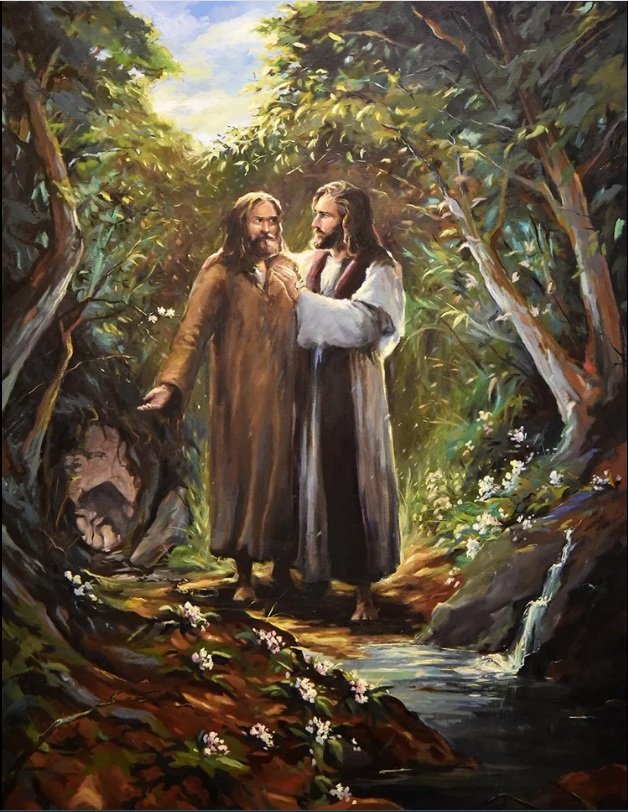
Michael Corsini’s Jesus the True Friend (Original Painting).
Image used with permission of the artist.
I write this in the middle of multiple crossroads. I am an adult child of divorce, a late immigrant to Canada from the Philippines, and a fiancé. I find these parts of my life meeting in recent moments – both in the context of preparing for my marriage and as a participant of the 2026 LGW Online Support Group. It is as if my parts are mingling for the first time. For some reason, they are realizing something common between them. They are finding similarities that stem from the same familial wound.
I was born and raised in the Philippines. I enjoyed my childhood as my family had multiple routines. We would always have lunch at noon and have dinner at six in the evening. My paternal grandparents and I would watch the waves of Laguna de Bay on weekend afternoons. As a cradle Catholic, I knew the Catholic faith at an early age. I remember my first communion and my early struggles with holding the rosary. Moreover, my faith felt familiar because my parents and I would attend Sunday Mass regularly. We would fulfil our Sunday obligation before heading to the local mall for groceries and treats. These routines, as I remember them now, provided nourishment for me as a child.
My life began to change when my mother went abroad for work. I was eleven when my mother, in tears, hugged me in farewell before flying to Saudi Arabia for the first time. My father was now far from his wife, and I from my mother. I would still see her once a year for Christmas but I knew a palpable change had already arrived. The routines that felt so familiar were now being challenged by change.
Between the ages of eleven and nineteen, I would see my mother sparingly. She was occupied with moving from Saudi Arabia to Canada; she was hopeful that our family would reunite in British Columbia. Due to the need to stay in Canada to secure citizenship, my mother had stayed there for some time as I was becoming a young adult. In the Philippines, my father and I were together though we both knew we were missing an important family member. At this time, I knew that my family was different, although not necessarily broken. I would carry this with me as I entered university in the Philippines.
As a humanities major, I have learned to examine the realities of the human condition. Be it in literature, art, history, or philosophy, the human being is geared towards an end. That telos, or vision, sustains everyday action and thought. In one of my university courses in the Philippines, we were tasked with engaging in disputatios – structured debates that explore arguments, dissect objections, and uncover truth.
I still remember an impactful session where my classmates and I dove into a famous quote attributed to St. Irenaeus of Lyons: “for the glory of God is a living man; and the life of man consists in beholding God.” [1] The aforementioned quote is often simplified to “the glory of God is man fully alive.” As a university student, I was not sure how this quote would resonate with me; but after years of journeying, suffering, and healing, I consider this passage a compass for the wayfarer that I am. What does it mean to be fully alive? What does it mean to give glory to God with my life?
I remember exploring this quote in the first few years of my family breakdown. Not only was my mother far away, but I knew that my family was no longer whole. I was eighteen when I learned I had a younger half-sister from my father’s side. She and I were more than fifteen years apart. As my father confessed this, I knew that I would no longer be the same. In my heart, I was not sure what being fully alive meant when my circumstances were broken and dysfunctional.
As a Filipino among Filipinos, I was exposed and introduced to numerous families. I would meet them in university and throughout the different circles I inhabited. Most of the families I met looked intact or, at least, had two present parents and some sense of filial tradition. I would see them attending Mass together or posting family photos on social media. In comparison, I came from a broken home with crumbling family stability. I would often go to Mass alone and had little to no stories about family escapades. I thought to myself, perhaps I cannot be fully alive because my life is unlike those around me. Perhaps I have been disqualified from this calling altogether.
I carried this false identity when I moved to Canada at twenty-two. This was yet another chapter that felt foreign from my childhood routines in the Philippines. My mother and her parents were already in Canada by 2012. With great anticipation, and I assume much heartbreak, my mother successfully sponsored my father and I to move as permanent residents. My father fully immigrated in 2015 while I arrived some years after in 2018 as I finished my university degree.
As someone who had already felt inferior in my home country, it was easier for me to consider myself of lower value in a foreign place. I had to start over in Metro Vancouver where almost no one knew me except my family. At that time, we all lived under the same roof but the tension was thick. It was unlike the Filipino home I was raised in. They were all eager to welcome me into a new chapter, though I was afraid how my family would contend with the brokenness. I was unsure what all this newness would mean. How would I be fully alive in a strange country and in a broken family?
I bore an earnest question in my first few years in Canada: would my family heal? Would I experience the wholeness of family life once more? There was some hope as we had all lived under the same roof. For the first time in over eight years, we three were all together, albeit with some strain. It may have been difficult to recreate old routines, but perhaps we could make new ones now that I was an adult.
Despite my expectations, I would be met with much disappointment. By 2019, my father would move out of our home to pursue better working conditions in a different Canadian province. Our new reunion was shattered once more as yet another family member moved away. I would later learn that he was living with another woman. By 2021, my mother would also move out to pursue a relationship born from online dating. She had uprooted herself to live with a new man in a faraway city. I was left to live with my grandfather, the father of my mother. By 2021, I knew that my parents had fully separated. I knew that my family was as broken as I could imagine. My parents had both communicated how they no longer wanted to repair their marriage.
As an adult child of divorce and as a late immigrant, I felt convinced that I had little value to the world. I would often repeat to myself that God had no longer favored me, that I was an abandoned sheep in His flock. I thought God had loved those with intact families more. Throughout my initial encounters in Canada, I was afraid people would discover I came from a broken family. I was afraid that people would see me with shame. In response, and as a means of self-protection, I would either hide myself or disregard myself openly. Both of these responses offered a false sense of peace.
I lived with this false identity for over three years. I remember shirking away from social opportunities and friendships out of fear that I would be seen as less. One could say that I was in a state of cynicism. How could I be fully alive now that both of my parents felt estranged, and that they are both with other partners? How do I live as a son when both parents have distanced themselves in a cold country? I remember disqualifying myself even further. I am not worth much because of my circumstances. I am not like those around me because they come from more ideal situations. I am the only one who suffers in this way. I would repeat these to myself in the quiet of prayer, often asking God why He had led me down this path.
I would later enroll myself in Duc in Altum, a young adult discernment program led by the Salesian Sisters of St. John Bosco. I registered because I was in need of refreshment and community, two things that the program leaders had emphasized in the info session. How would God speak to me through this program? How would my wounds as an adult child of divorce be given attention? I considered these questions as I embarked on this one-year program. I would later learn what was pivotal to my turning towards God.
My healing journey truly began when I realized that the narratives circling my heart were lies obstructing me from my true identity. I had to be confronted with my true identity as a child of God! I had to be confronted by the goodness I possessed despite the circumstances of my life. I had to be convicted by the peace that God can make! It was uncomfortable to consider life in a different way because I had operated from multiple lies in the past. Instead, I was beginning to see God’s goodness radiating from community and friends despite the wounds I carried. I learned that it was indeed possible to be fully alive despite my imperfect circumstances.
I am still learning, through the grace of God, that I am not my wounds, nor am I the wounds my family has inflicted on me. I learned this as I have been received by fellow Catholic young adults, and my fiancée, in a holistic way – that I can be seen for both my goodness and shortcomings. Moreover, the shortcomings I suffer from do not disqualify or remove the goodness I innately possess as a child of God. This was a true revelation for me after years of discounting myself. I am good, and I can be fully alive in spite of all that has happened.
I close by sharing how I best understand St. Irenaeus’ exhortation. To be fully alive is to honour God in all seasons of my life, that I have never been disqualified from serving as a radiant reflection of the Trinity. This is not to say that my pain does not matter, but that my divine sharing in God’s love overshadows anything that could happen to me. I am still called to live with faith, hope, and charity in the midst of whatever mire I find myself in. I realize now that I – alongside many other adult children of divorce – have the opportunity to glorify God through the suffering He has allowed. I can be fully alive, and perhaps even more so as I choose to praise God in the valleys of my family breakdown.
As I continue in the years that the Lord allows, I now ask myself how I can best honour Him despite my share in His cross. How can I be merciful towards my parents who have hurt me in ways known and unknown to them? How can I be more merciful towards myself in light of my true divine identity? How can I rewrite the narratives in my heart with the truth of God’s everlasting love? I bring these questions to the forefront whenever I am tempted by the lies of the enemy. In return, I want to always inch towards the goodness of the Lord. I know that He is with me always, and that He will transform anything and everything that is offered back to Him.
Endnotes:
Irenaeus. (n.d.). Against heresies (A. Roberts & J. Donaldson, Trans.). New Advent.https://www.newadvent.org/fathers/0103.htm (Original work published ca. 180).
Prayer:
God the Father, God the Son, and God the Holy Spirit, thank You for loving me. I ask for the grace to be fully alive in the days You give to me. Help me to live as an earnest and authentic reflection of Your Love. I surrender myself to Your grace so that every moment of my life can be an encounter with You. Amen.
About the Author:
Arri is a school teacher in British Columbia. He enjoys looking for God in creation, poetry, and encounter. He hopes to emulate St. Joseph and St. André Bessette in their meekness, simplicity, and holiness.
Reflection Questions for Small Groups or Individuals:
Put your own story into dialogue with St. Irenaeus of Lyons quote: “for the glory of God is a living man; and the life of man consists in beholding God.” What comes into your mind and heart when you do this? Where do your mind and heart meet in this conversation?
How do you deal with the problem of suffering as an Adult Child of Divorce? How does Arri’s article help you put that suffering in a larger context?
What does it mean to be fully alive? What does it mean to give glory to God with my life?
Think of a time when you were confronted with your true identity as a child of God, confronted by the goodness you possess despite the circumstances of your life, and/or convicted by the peace that God can make within you. Dwell there for a time and then share your experience. What came into your mind and heart?
Pray with Romans 8:28“We know that all things work for good for those who love God, who are called according to his purpose.” Do you believe that God can make use of all of the events of your life? Do you believe that all aspects of your life can be redeemed?
How can you be merciful towards your parents who have hurt you in ways known and unknown to them? How can you be more merciful towards yourself in light of your true divine identity? How can you rewrite the narratives in your heart with the truth of God’s everlasting love?
Which parts of Arri’s story resonated with you the most?
Healing happens when we journey together. To aid you in this journey, we created a quiz to better understand the impact of parental divorce on your life.
Answer 35 questions and we will send you a personalized report.
If you’re an adult child of divorce or separation, this quiz is a space to reflect on how your past may still be impacting your present—especially in areas like faith, identity, relationships, and family life. You’ll respond to a series of statements that invite honest self-reflection. At the end, you will receive insight into your potential, deepest areas of pain—and suggestions for next steps in healing.