
“Wonderful” & “Stay Together for the Kids”: A Reflection on Two Rock Songs

Phil Dolby, CC BY 2.0, via Wikimedia Commons
I am proud to say that as an adult I have an appreciation for many different kinds of music. What I find so compelling about so many pieces or movements is how the artist is able to convey some truth that is often overlooked or unspoken. Although many discussions about art and music revolve around the topic of beauty, I would like to spend a moment reflecting on another transcendental: that of truth.
If art was “subjective self-expression,” or if beauty was merely “in the eye of the beholder,” then there would be no coherent or objective message to which we can relate. What allows a song to reach so many hearts is that it touches on something intelligible, for one thing, and something that resonates with a more universal human experience. In other words, we sense what truth the artist is trying to say (in a unique and beautiful marriage of message and medium), and we can relate to it in awe and wonder: “Wow! I recognize what the artist is saying. I have never seen it quite like this before.”
This is the problem with so much modern art, right? The artist is not trying to communicate some profound truth; he is trying to shock us with a hot-take or give a manifesto that only he can understand. Anyway, I digress.
There are two rock songs about parental divorce from the early 2000’s which made a distinct impression on me. Although I was only eleven or twelve years old at the time, and my family was still intact, these songs conveyed a perspective to me that opened my eyes to the experience of children of divorce. Many years later, after my own parents divorced, I remembered these songs and could give real assent to their message. Tragic though they may be, they speak the truth in unique ways. Today, I would like to share with you my reflections on them.
Wonderful by Everclear
Do you remember a song called “Wonderful,”by a band called Everclear? It was popular in the year 2000. I was in sixth grade at the time, and I remember hearing it every day on the way to soccer practice. Most of their songs had a rougher sound than “Wonderful,” but “Wonderful” was their first major hit, reaching #11 on the US Billboard Hot 100.
Everclear’s lead singer, Art Alexakis, admitted in interviews years ago that this song reflects parts of his own experience as a child of divorce. [1] In the first verse, a young child can hear his mom and dad scream as they fight with each other. They say bad words that make the kid want to cry. He closes his eyes and imagines that angels (cf. CCC 336) are there to comfort him. He muses about how promises mean everything to little children, for whom the world is so big and scary. Apparently, however, one or both parents would try to make light of the situation, saying that everything is wonderful now.
In the second verse, the child goes to school and tries to pretend that everything is fine. He likes to laugh a lot, so that nobody would suspect that he is sad. When the bell rings, he goes home to his room and closes his eyes—this time, he makes believe that he has a new life altogether. In the music video, two children are portrayed each splitting into two versions of themselves, depicting the inner experience of feeling of being torn apart.
As the song continues through another chorus and into the bridge, the tension of the song begins to rise. The child now raises his voice, exclaiming that he does not want to be told that “he will understand one day,” or that his parents have “grown apart.” He does not want to meet the new people that his parents are dating, but he also does not want them to break up and start the process all over again. He wants his life to be the same, just like it used to be. The song reaches a crescendo as the child belts out an angsty cry: “I don’t want to hear you tell me, ‘Everything is wonderful now!’ NO!” And just when you think the song will begin to calm, he repeats this refrain again and reaches an even higher note. After this apex, the music calms but the singer continues to echo again and again, “Yeah… ‘Everything is wonderful now…’ ‘everything is wonderful now…’” There is no proper finale to the song; it simply fades out, leaving the listener with a feeling that this is never-ending.
At the very end of the video, Art can be seen wiping away a tear from his own eye, showing the viewer that this was in fact personal.
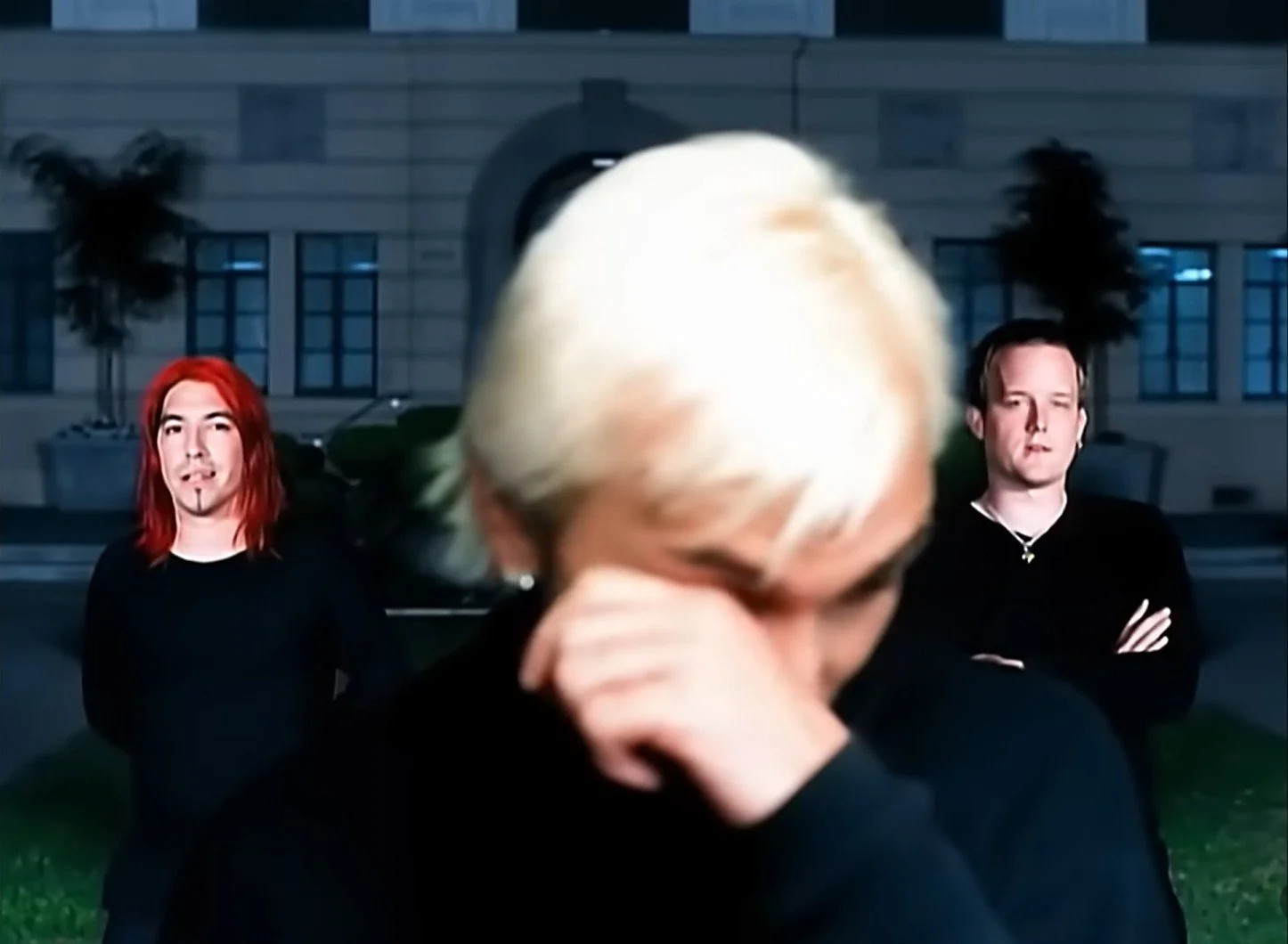
Art wiping away a tear near the end of the music video.
Stay Together for the Kids by Blink-182
Another rock song composed to give voice to the pain of parental divorce is a song called Stay Together for the Kids, by Blink-182. This one is also somewhat autobiographical, with band members Tom DeLonge and Mark Hoppus drawing on their experiences as children of divorce. Although Stay Together for the Kids does not tell a story the same step-by-step way that Wonderful did, what makes it particularly interesting is how the production of the music video(s) unfolded.
Originally, the band had decided that the music video would feature a wrecking ball smashing into a home—a clear analogy for what divorce does to the family. Mixed in with these clips of a home being destroyed are clips of a kid at a skate-park–a link to Tom DeLonge’s own childhood.
This filming took place September 9-11, 2001. Yes, the days leading up to 9/11. A week later, the band and production crew got together and agreed that the wrecking ball video would be too evocative of the 9/11 events, and that they would need to record a new video from scratch. Note: they continued to think that the wrecking ball analogy was apt; they simply admitted that such imagery would be too triggering in that cultural moment.
Sure enough, as they tried releasing the video as-is, they received some serious push-back from media outlets. As a matter of fact, MTV outright refused to play it.Here is what Travis Barker, drummer of Blink-182, said about this development in his memoir, Can I Say: Living Large, Cheating Death, and Drums, Drums, Drums:
…it was time to make a video for “Stay Together For The Kids.” The label gave us a million-dollar budget. “This video is going to be huge,” they told us…
…It was a huge production, with cops blocking off a street in Orange County. The concept of the video was that we were playing inside this house while it was being destroyed. A wrecking ball was hitting the house, and everything was falling to pieces. The idea was that it would look the same way that kids feel in the middle of a divorce—like mass destruction. The only hang-up: the day we were shooting was September 11, 2001.
We were in the middle of shooting when we found out that there was a terrorist attack. Two planes had hit the World Trade Center and thousands of people were dead. We didn’t know what to do, so we finished shooting the video. It was a really messed-up day. Once it was done, MTV wanted to see the footage, which looked way too much like all the painful things that happened in New York. There were pieces of houses falling and kids crying. MTV told us that it was in bad taste and they’d never play it. We had to make a special version without the wrecking ball, and without the house being destroyed. [2]
The new version of the video featured imagery of angry teens in an empty house—much safer. Now that twenty-five years have passed since 9/11, both versions of the music video have been accepted by the public and uploaded to YouTube. Here are the two versions played together side-by-side:
In summary, both Wonderful and Stay Together for the Kids give clear voice to the devastating consequences for children of divorce, in different ways. Wonderful spoke the truth about our inner experience, especially in those moments where words seem to not be enough. Stay Together for the Kids spoke truthfully about the devastation of parental divorce being akin to a weapon of mass destruction in our homeland. Even as a twelve-year-old boy in an intact family, I could sense the truth of these songs.
I want to end this piece with a note of hope. We can recover, in a sense, what has been lost. No, our parents are not getting back together, but where one home was destroyed, a new one can be built. Through our own healing journey, we can provide for the next generation a home that will stand firm and serve as a beacon of hope for many.
Footnotes:
Art Alexakis did an interview with Professor of Rock where he discusses this and other raw topics such as sex and drugs.
Barker, T., & Edwards, G. (2015). Can I say : living large, cheating death, and drums, drums, drums (First edition). William Morrow, an imprint of HarperCollinsPublishers. P.159-160
For a prayer, we encourage you to meditate on this passage from Scripture (Revelation 7:13-17):
Then one of the elders spoke up and said to me, “Who are these wearing white robes, and where did they come from?” I said to him, “My lord, you are the one who knows.” He said to me, “These are the ones who have survived the time of great distress; they have washed their robes and made them white in the blood of the Lamb. “For this reason they stand before God’s throne and worship him day and night in his temple. The one who sits on the throne will shelter them. They will not hunger or thirst anymore, nor will the sun or any heat strike them. For the Lamb who is in the center of the throne will shepherd them and lead them to springs of life-giving water, and God will wipe away every tear from their eyes.”
About the author:
Alexander Wolfe grew up in western Pennsylvania and studied Theology at DeSales University (2008-2011). Through the experience of seeing his parents get divorced while he was in college, Alex decided to study at the John Paul II Institute for Studies on Marriage and the Family in Washington, D.C. He completed the Master of Theological Studies degree and coursework for the Ph.D. (2012-2017)
From 2018 to 2024, Alex served as the Assistant Director in the Office of Marriage, Family, and Respect Life at the Diocese of Arlington, where he started the first diocesan Life-Giving Wounds chapter outside D.C./ Maryland. During that time, he also served as the Content and Support Group Advisor for Life-Giving Wounds and as a member of the Life-Giving Wounds traveling team.
In 2024, Alex joined Life-Giving Wounds full-time, and now serves as the Associate Director of Programs and Development. In this role, he continues to help start new Life-Giving Wounds chapters across the country, provide support for the 35+ existing chapters, develop new chapters and programs, assist fundraising efforts, and much more. He continues to be based in Washington, D.C.
Reflection Questions for Small Groups or Individuals:
What thoughts and emotions arise in you as you listen to these two songs?
Which song speaks more directly to your experience as an ACOD and why?
What in the artists’ background resonated with you as you learned, briefly, about their lives? How did it impact their art?
Would you describe parental divorce as a weapon of mass destruction? Is this going too far or is there a kernel of truth here, in your experience?
Do you feel as though it is possible to rebuild, as the author suggests at the end of this piece? Why or why not?
Do you know of any other songs that were written about parental divorce? If so, please share them in a comment below.
Healing happens when we journey together.
If Alex’s reflection resonated with you, consider joining an upcoming Life-Giving Wounds retreat or support group. You do not have to carry the darkness alone.
Together, we can walk into the light.